The Listening Iceberg
Every conversation has two layers. One is visible. The other is hidden. The visible layer consists of the words people speak and the messages they write. It includes conversations during meetings, emails, reports, presentations, chat messages, and feedback sessions. These words are important because they communicate facts, opinions, decisions, and questions. They are what we immediately hear and see.
Susaan Demers-Ghajar
7/22/20265 min read
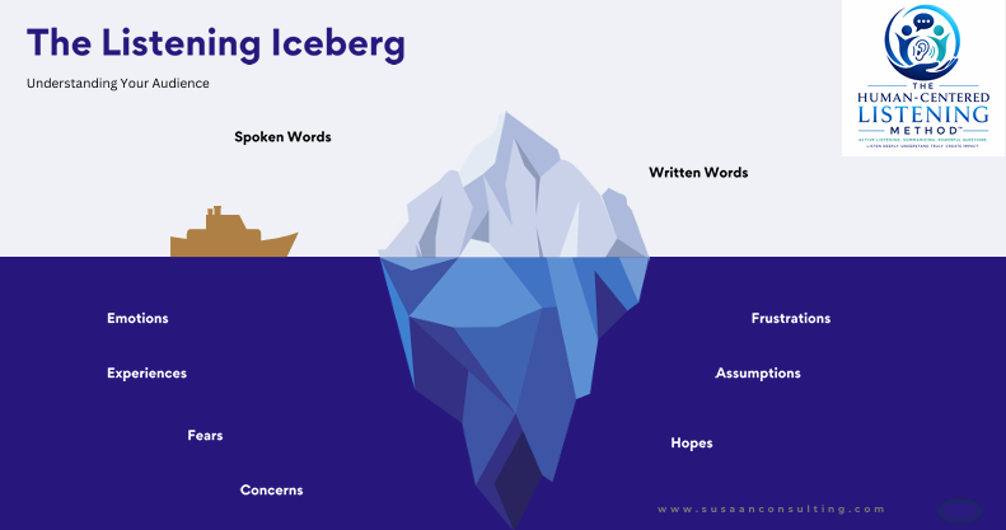
Yet, just like an iceberg, this visible layer represents only a small part of the whole picture.
Beneath the surface lies everything that truly influences the conversation. Emotions, experiences, fears, concerns, frustrations, assumptions, and hopes remain largely invisible, yet they shape every response, every decision, and every action.
This is the essence of The Listening Iceberg.
Active listening is not simply about paying attention to spoken or written words. It is about developing the curiosity to explore what lies beneath them. It is about understanding people before trying to influence them. It is about recognizing that every conversation contains far more than language alone.
When we learn to listen beneath the surface, conversations become richer, relationships become stronger, and change becomes more human.
The Tip of the Iceberg
Most organizations communicate exceptionally well above the waterline. They write detailed emails. They organize presentations. They develop communication plans. They create roadmaps and answer frequently asked questions.
All of these efforts focus on spoken and written words. While these activities are essential, they often create the illusion that communication is complete simply because information has been shared. Information, however, is not the same as understanding. A leader may clearly explain a new strategy, but employees can still leave the meeting feeling uncertain.
A manager may send a perfectly written email, yet team members may still experience anxiety. A project team may communicate every milestone, while stakeholders continue to feel disconnected. Words explain what is changing. They rarely explain how people experience that change. That experience exists beneath the surface.
Emotions Drive Conversations
Every conversation carries emotion. Sometimes those emotions are obvious. More often they remain hidden. Someone may appear calm while feeling overwhelmed. Another person may smile while privately worrying about the future.
Someone else may sound frustrated while actually feeling disappointed or insecure. These emotions influence how people interpret every message they receive.
During organizational change, leaders often focus on communicating the right information. They carefully prepare presentations, answer questions, and explain business reasons. Yet people rarely make decisions based on information alone.
Human beings respond emotionally before they respond rationally. Ignoring emotions does not make them disappear. It simply pushes them further beneath the surface. Active listeners understand that emotions deserve attention just as much as facts.
Experiences Shape Perception
No one enters a conversation without a history. Every person brings previous experiences into the room. Someone who has experienced successful organizational change may respond with optimism.
Someone who has lived through repeated restructurings may immediately become cautious. An employee who previously felt ignored may hesitate to speak openly. Another who has always been encouraged to contribute ideas may participate confidently.
People do not only hear today's message. They interpret today's message through yesterday's experiences. This explains why two people can hear exactly the same presentation while reaching completely different conclusions.
Great listeners recognize that people's experiences deserve exploration rather than assumption.
Fears Often Speak Indirectly
Fear rarely introduces itself openly. Very few people say, "I am afraid."
Instead, fear disguises itself as practical questions or critical comments. Someone may ask whether the timeline is realistic. Another may question whether the organization is making the right decision.
Someone else may repeatedly focus on potential risks. On the surface, these appear to be logical concerns. Beneath the surface, the real message may be something entirely different.
"I am afraid I will fail." "I am worried about losing my role." "I do not know whether I have the skills to succeed." "I am uncertain about what this means for my future."
When leaders only answer the visible question, they often miss the hidden concern. When they become curious about the fear beneath the words, genuine dialogue begins.
Concerns Need Curiosity
Many conversations become ineffective because people respond too quickly. Someone raises a concern. Another person immediately offers reassurance. The intention is positive. The impact is often disappointing.
People rarely want their concerns dismissed within seconds. They first want those concerns to be understood. A simple question such as, "Can you tell me more about what worries you?" often creates more value than several minutes of explanation.
Curiosity communicates respect. It tells people that their perspective matters. Once people feel heard, they become far more open to new ideas and different perspectives. Understanding almost always comes before commitment.
Frustrations Tell a Story
Frustration is another hidden element beneath the waterline. It often appears as resistance, criticism, or disengagement. Yet frustration usually develops over time. Perhaps someone has repeatedly shared ideas that were ignored.
Perhaps previous promises were never fulfilled. Perhaps communication has consistently been one directional rather than conversational. Eventually frustration becomes visible. Unfortunately, leaders often respond to the visible behavior rather than the invisible history that created it.
Active listening invites us to become curious about where frustration comes from instead of simply reacting to how it appears. Every frustration has a story. Listening helps us discover it.
Assumptions Influence Understanding
Every conversation includes assumptions. The speaker makes assumptions. The listener makes assumptions. Neither is fully aware of them. We assume we understand what someone means. We assume we know why they reacted the way they did.
We assume our interpretation is correct. Assumptions are efficient. Understanding requires curiosity. Active listeners replace assumptions with questions.
Instead of saying, "I know what you mean," they ask, "Can you help me understand?" Instead of concluding, they explore. Instead of judging, they remain curious. This simple shift transforms conversations.
People feel respected because they are invited to explain rather than defend.
Hopes Deserve Attention
Perhaps the most overlooked part of The Listening Iceberg is hope. During change, conversations often revolve around resistance, uncertainty, and risk. Far less attention is given to what people hope for.
Every employee hopes for something. Some hope to learn new skills. Some hope to contribute more. Some hope to feel appreciated. Others hope to find greater purpose in their work.
Hope creates energy. Hope inspires commitment.
When leaders discover what matters most to people, change stops being something imposed from above. It becomes something people can genuinely connect with. Questions such as, "What would success look like for you?" or "What are you hoping this change will bring?" reveal possibilities that facts alone can never uncover.
Listening Beneath the Surface
The Listening Iceberg reminds us that meaningful conversations begin where words end. Anyone can hear spoken words. Anyone can read written messages. True listening requires something more.
It requires patience. It requires curiosity. It requires the willingness to explore what remains invisible.
When someone says, "I am not convinced this change will work," the conversation should not end with another explanation. It should begin with curiosity.
"What makes you feel that way?"
"What concerns you most?"
"What would help you feel more confident?"
Questions like these invite people beneath the surface. They transform conversations from debates into dialogue. They create psychological safety because people feel genuinely heard instead of simply managed.
The Human Side of Change
Successful change is often described in terms of strategy, governance, planning, and communication. These elements are important. But they are not enough. Change succeeds when people choose to participate.
People choose to participate when they trust their leaders. Trust grows through conversations. Those conversations become meaningful when people feel understood.
The Listening Iceberg reminds us that understanding never comes from words alone. It comes from recognizing the invisible human experience beneath every conversation.
Every spoken sentence has an emotional context. Every written message has a personal interpretation. Every reaction has a story.
The more curious we become about what lies beneath the surface, the more effective our conversations become.
If you want to strengthen your ability to listen beyond spoken and written words, deepen your conversations, and build stronger relationships, explore our Active Listening eCourse at www.susaanconsulting.com.
The next time you enter a conversation, imagine an iceberg. Listen carefully to the words above the surface. Then become curious about the emotions, experiences, fears, concerns, frustrations, assumptions, and hopes that remain unseen.
That is where real understanding begins.
That is where trust is built.
And that is where meaningful, human centered change truly starts.
The Human Centered Change Method: curiosity creates commitment.