Why Lean, Agile, and Traditional Project Management Are All Part of The Human-Centered Change Method™
These resources are designed for leaders, consultants, project managers, HR professionals, transformation teams, and organizations seeking a more modern and human-centered approach to change management. Because successful transformation is not only about implementing processes. It is about helping people adapt, collaborate, and grow together in a continuously changing world.
Susaan Demers-Ghajar
6/10/20266 min read
Organizations today are transforming faster than ever before. Digital transformation, AI implementation, operational redesign, organizational restructuring, and evolving customer expectations are forcing businesses to rethink how they work. Yet despite enormous investments in transformation initiatives, many organizations still struggle with one persistent challenge: sustainable adoption.
Projects may be delivered on time. Systems may go live successfully. New processes may technically function as intended. But if people are not engaged, aligned, and supported throughout the transformation process, long-term success remains uncertain.
This is exactly why The Human-Centered Change Method™ was developed.
The Human-Centered Change Method™ is a modern approach to organizational transformation that places people at the center of change. Rather than focusing only on systems, timelines, or implementation frameworks, the methodology recognizes that transformation succeeds through human behaviour, trust, communication, leadership, collaboration, and adaptability.
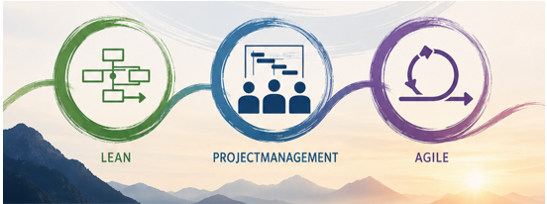
At its core, The Human-Centered Change Method™ combines strategic structure with human-centered thinking. It recognizes that organizations need operational discipline and flexibility at the same time. This is why Lean, Agile working methods, and Traditional Project Management all play an important role within the methodology.
These approaches are not competing philosophies. When applied correctly, they complement each other and create a stronger, more adaptive foundation for successful transformation.
More information about The Human-Centered Change Method™, tools, and eBooks is available through: www.susaanconsulting.com/webshop.
The Challenge With Modern Transformation
One of the biggest mistakes organizations make is assuming that one methodology can solve every transformation challenge. Some organizations attempt to apply Agile principles to every situation, even when structure and predictability are required. Others rely too heavily on traditional project governance, creating slow decision-making and limited flexibility. Some focus exclusively on efficiency through Lean, while underestimating the emotional and cultural impact of change.
The reality is that organizational transformation is far more complex.
Modern organizations operate in environments where uncertainty, rapid technological change, cross-functional collaboration, and continuous adaptation are becoming the norm. This means organizations need multiple capabilities simultaneously:
Strategic structure
Operational efficiency
Adaptability
Continuous learning
Human engagement
Clear governance
Innovation
Sustainable adoption
The Human-Centered Change Method™ recognizes that no single framework addresses all these needs alone.
Instead, the methodology integrates the strengths of Lean, Agile, and Traditional Project Management into one balanced, human-centered approach.
The Role of Traditional Project Management
Traditional Project Management remains extremely valuable in transformation initiatives, particularly in environments where clarity, governance, predictability, and accountability are critical. Large-scale transformation programs often involve:
Budget management
Regulatory compliance
Executive reporting
Risk management
Cross-functional coordination
Timeline dependencies
Vendor management
Strategic governance
Without structure, transformation can quickly become chaotic.
Traditional Project Management provides organizations with clear planning mechanisms, accountability structures, milestones, resource allocation, and governance frameworks that help maintain organizational alignment throughout complex initiatives. Within The Human-Centered Change Method™, Traditional Project Management creates stability and strategic oversight. However, the methodology also recognizes the limitations of purely traditional approaches.
In many organizations, overly rigid project structures create frustration, reduce adaptability, and slow innovation. Teams may feel disconnected from decision-making, while employees experience change as something being imposed upon them rather than developed with them.
This is where Agile working methods become essential.
Why Agile Matters in Human-Centered Change
Agile working methods transformed modern project delivery because they introduced greater flexibility, collaboration, iterative learning, and responsiveness to change. Agile recognizes that organizations often cannot predict every challenge or stakeholder need in advance. Instead of relying solely on fixed long-term planning, Agile encourages continuous feedback, rapid adaptation, incremental delivery, and close collaboration between teams and stakeholders.
This aligns strongly with the principles of The Human-Centered Change Method™. Human-centered transformation requires organizations to listen continuously, involve stakeholders early, adapt communication strategies, and respond to emerging human dynamics throughout the transformation process.
Agile supports this by creating:
Shorter feedback loops
Higher stakeholder involvement
Greater transparency
Faster learning cycles
Cross-functional collaboration
Incremental improvement
Importantly, Agile is not only about speed.
The strongest Agile environments create psychological safety, encourage experimentation, and empower teams to contribute actively to solutions. This directly supports employee engagement and ownership during periods of change. Research on Agile transformation consistently highlights the importance of collaboration, learning, and adaptability in complex organizational environments. (Springer)
Within The Human-Centered Change Method™, Agile helps organizations remain adaptive while maintaining strong stakeholder engagement throughout transformation.
The Importance of Lean Thinking
While Agile focuses heavily on adaptability and iterative delivery, Lean introduces another essential dimension: value optimization. Lean principles focus on improving efficiency, reducing waste, streamlining workflows, and maximizing customer value. Lean thinking encourages organizations to critically evaluate processes, eliminate unnecessary complexity, and create systems that support continuous improvement.
This becomes particularly important during transformation initiatives where organizations risk creating additional complexity instead of simplifying operations. Lean thinking supports The Human-Centered Change Method™ in several ways.
First, it encourages organizations to focus on what genuinely creates value for both the business and its people. Second, it helps reduce friction within processes, which improves employee experience and operational effectiveness. Third, Lean promotes continuous improvement rather than one-time transformation. This mindset is critical in modern organizations where change is no longer occasional. It is continuous.
Lean and Agile are increasingly combined within modern project and transformation environments because together they balance adaptability with operational efficiency. The Human-Centered Change Method™ integrates Lean principles not simply to improve efficiency, but to create healthier, more sustainable transformation environments where people can work more effectively with less unnecessary complexity.
Why Human-Centered Change Requires All Three
Many organizations fall into the trap of treating methodologies as isolated systems. In reality, successful transformation often requires all three approaches working together.
Traditional Project Management provides structure and governance. Agile provides adaptability and collaboration. Lean provides efficiency and continuous improvement. The Human-Centered Change Method™ brings these elements together through a human-centered lens. This is critical because organizational transformation is not purely operational. It is deeply human.
Employees experience uncertainty, shifting expectations, emotional responses, evolving team dynamics, and changing organizational identities throughout transformation initiatives. Technical implementation alone does not guarantee adoption. Organizations need approaches that support both operational execution and human engagement simultaneously.
For example:
A large digital transformation program may require traditional governance structures to manage budgets and timelines. At the same time, Agile teams may be necessary to adapt solutions quickly based on stakeholder feedback, while Lean principles help streamline workflows and remove unnecessary process complexity.
Without balance, transformation becomes either too rigid, too chaotic, or too inefficient. The Human-Centered Change Method™ helps organizations create equilibrium between these approaches while maintaining focus on the people impacted by change.
Moving Beyond Methodology Wars
One of the most unproductive trends in modern project and change management is the tendency to position methodologies against one another. Organizations often ask:
“Should we use Agile or traditional project management?”
“Should we focus on Lean or Agile?”
“Is traditional project management outdated?”
These questions oversimplify the reality of transformation. The most effective organizations understand that methodologies are tools, not identities. Different transformation contexts require different levels of structure, flexibility, governance, experimentation, and efficiency.
The Human-Centered Change Method™ encourages organizations to move beyond methodology wars and instead focus on what creates sustainable human adoption and organizational value. This creates a far more pragmatic and adaptable approach to transformation.
Learning Through the eBooks
To help organizations, leaders, and professionals better understand these approaches, Susaan Consulting has developed multiple eBooks covering Lean, Agile working methods, and Traditional Project Management within modern transformation environments.
These eBooks are designed to provide practical insights, strategic guidance, and human-centered perspectives on how organizations can successfully navigate change in increasingly complex environments.
The eBooks explore topics such as:
Human-centered transformation
Agile collaboration and adaptability
Lean efficiency and continuous improvement
Traditional governance and project structure
Stakeholder engagement
Organizational culture
Sustainable change adoption
Leadership during transformation
Rather than treating these methodologies as isolated systems, the eBooks explain how organizations can combine them effectively to create stronger transformation outcomes. This integrated perspective is becoming increasingly important as organizations face accelerating technological, operational, and cultural change.
Why Organizations Need a New Approach
The future of transformation requires organizations to become more adaptive, collaborative, efficient, and human-centered at the same time. Employees today expect greater involvement, transparency, and psychological safety during periods of change. Leadership models are evolving. AI and digital transformation are accelerating operational complexity. Organizational cultures are shifting toward continuous learning and adaptability.
Traditional change models alone are no longer sufficient. Organizations need transformation approaches that combine structure with flexibility, operational discipline with empathy, and strategic execution with human understanding. The Human-Centered Change Method™ was developed to address this reality.
By integrating Lean, Agile, and Traditional Project Management into one people-focused methodology, organizations can create transformation environments that are more resilient, adaptive, and sustainable.
Explore the eBooks and Tools
The Human-Centered Change Method™, related tools, and the eBooks on Lean, Agile, and Traditional Project Management are available through: www.susaanconsulting.com/webshop
These resources are designed for leaders, consultants, project managers, HR professionals, transformation teams, and organizations seeking a more modern and human-centered approach to change management.
Because successful transformation is not only about implementing processes.
It is about helping people adapt, collaborate, and grow together in a continuously changing world.