Why the Influence & Resistance Grid™ is Essential for Successful Change Management
This Grid is part of the Human-Centered Change Method™ and the Stakeholder Mapping Toolkit™. It is free available for you to use.
Susaan Demers-Ghajar
5/26/20265 min read
In every transformation project, leaders often focus on strategy, technology, timelines, and deliverables. Yet many organizational changes still fail to achieve lasting adoption. The reason is rarely the strategy itself. More often, it is because organizations underestimate the human side of change.
People respond to change in different ways. Some embrace it immediately, others remain cautious, and some actively resist it. Understanding these reactions early is one of the most important factors in successful change management. This is exactly where the Influence & Resistance Grid™ becomes a powerful tool.
As part of The Human-Centered Change Method™, the Influence & Resistance Grid™ helps organizations identify how stakeholders are likely to respond to change and how much influence they have on others. Instead of treating resistance as a problem to eliminate, the grid encourages leaders to understand people, anticipate reactions, and engage stakeholders more effectively.
What Is The Human-Centered Change Method™?
The Human-Centered Change Method™ is a practical and people-focused approach to organizational transformation. It is built on the idea that successful change happens when organizations place human behavior, emotions, communication, and participation at the center of transformation efforts.
Traditional change management often focuses heavily on processes, structures, and implementation plans. While these elements are important, they do not automatically create engagement or adoption. Employees do not simply change because a new system or strategy is introduced. They change when they understand the purpose, feel involved, and trust the process.
The Human-Centered Change Method™ helps organizations move beyond transactional change management by focusing on:
Stakeholder understanding
Psychological safety
Human behavior and motivation
Communication and involvement
Trust and collaboration
Sustainable adoption
At the core of this methodology lies one critical principle: people support what they help shape. This means organizations need tools that not only map processes but also help leaders understand the people impacted by transformation. One of the most effective tools for this is the Influence & Resistance Grid™.
Why Stakeholder Mapping Matters
Every change initiative impacts people differently. Senior leaders may see strategic opportunities, while frontline employees may worry about workload, uncertainty, or loss of control. Some stakeholders may feel excited, while others may fear disruption. Without stakeholder mapping, organizations often make dangerous assumptions:
“Everyone understands the vision.”
“People will adapt once training is provided.”
“Resistance will disappear over time.”
In reality, unmanaged resistance can spread quickly through teams and significantly slow down transformation.
Stakeholder mapping provides clarity. It allows organizations to identify:
Who supports the change
Who may resist the change
Who has influence over others
Where engagement efforts are most needed
Which relationships require trust-building
Rather than reacting to problems after they appear, leaders can proactively design engagement strategies that reduce friction and increase alignment.
What Is the Influence & Resistance Grid™?
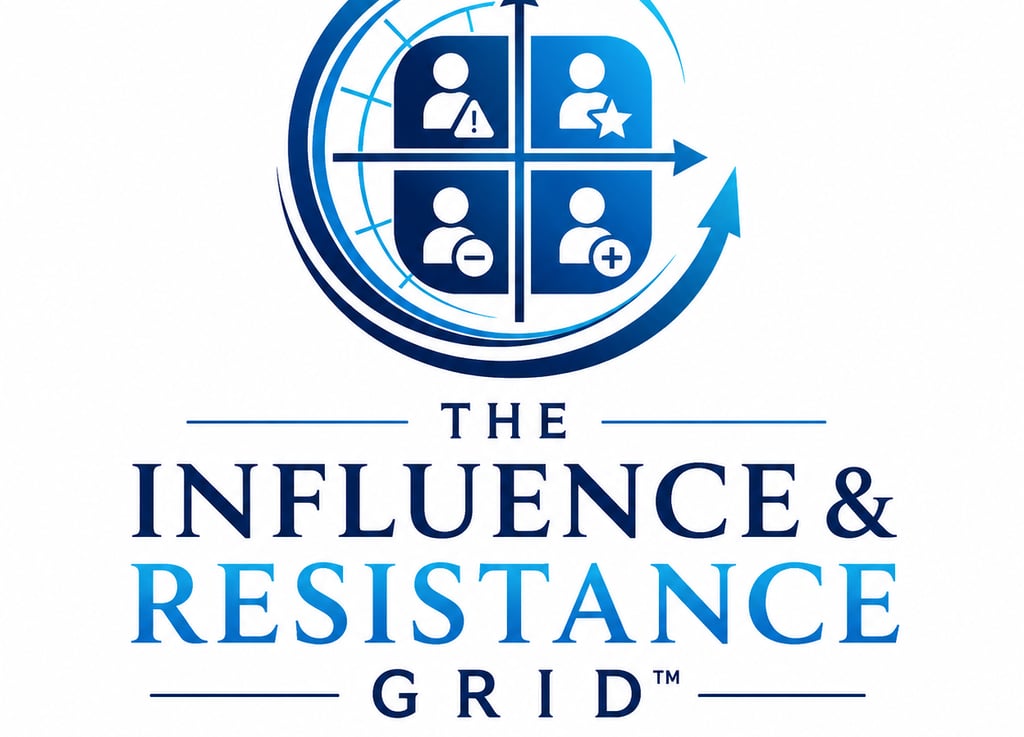
The Influence & Resistance Grid™ is a stakeholder analysis tool designed to help organizations assess stakeholders based on two critical dimensions:
1. Influence
This measures how much impact a stakeholder has on the organization, project, or other employees. Highly influential stakeholders may include:
Senior executives
Team leaders
Informal influencers
Subject matter experts
Long-term employees with strong networks
These individuals can significantly shape how others perceive the change initiative.
2. Resistance
This measures the degree to which a stakeholder is likely to resist the proposed change. Resistance can appear in different forms:
Open disagreement
Passive disengagement
Delayed decision-making
Low participation
Emotional skepticism
Fear of uncertainty
Importantly, resistance is not always negative. In many cases, resistant stakeholders provide valuable insights into risks, communication gaps, or operational concerns that leaders may have overlooked. The grid helps organizations visualize stakeholders according to these two dimensions, creating a clearer picture of where engagement efforts should be focused.
The Four Stakeholder Categories
Once stakeholders are plotted on the grid, organizations can identify four general categories.
High Influence / High Resistance
These stakeholders require immediate attention. Because they have significant influence and high levels of resistance, they can strongly affect adoption across the organization. Ignoring this group can create major barriers to implementation. The goal here is not to “win” arguments but to understand concerns, involve stakeholders early, and build trust through dialogue.
Strategies may include:
One-on-one conversations
Active listening sessions
Inclusion in decision-making
Co-creation workshops
Transparent communication
In many cases, stakeholders in this category become strong supporters once they feel heard and involved.
High Influence / Low Resistance
These are your potential change champions. They already support the transformation and have influence within the organization. These stakeholders can help communicate the vision, encourage adoption, and build momentum. Organizations should actively empower this group by:
Providing clear messaging
Involving them in leadership communication
Giving visibility to their support
Encouraging peer advocacy
These stakeholders often become essential ambassadors for change.
Low Influence / High Resistance
This group may not significantly impact organizational direction, but their resistance still matters. Ignoring them can lead to disengagement, frustration, and local team-level disruption. The focus should be on:
Communication
Clarity
Empathy
Support and reassurance
Sometimes resistance in this group is driven by fear, uncertainty, or misunderstanding rather than opposition to the actual change itself.
Low Influence / Low Resistance
These stakeholders typically require less intensive engagement but should still remain informed and included. Even when resistance is low, people want clarity and transparency during periods of transformation. Consistent communication helps maintain trust and organizational stability.
Why the Grid Is So Powerful
The real strength of the Influence & Resistance Grid™ lies in its simplicity and strategic value. Many organizations treat stakeholder engagement as a generic communication exercise. They send the same messages to everyone and hope adoption will follow.
But human behavior is more complex than that. Different stakeholders require different engagement strategies. Some need information, others need reassurance, and some need active involvement. The grid helps leaders:
Prioritize engagement efforts
Identify hidden influencers
Anticipate resistance early
Reduce communication blind spots
Build targeted stakeholder strategies
Improve adoption outcomes
Most importantly, it shifts the mindset from “managing resistance” to understanding people. This is a fundamental principle within The Human-Centered Change Method™.
Resistance Is Data, Not Failure
One of the biggest misconceptions in change management is the idea that resistance should be eliminated as quickly as possible. Human-centered change takes a different perspective. Resistance often contains valuable information.
Employees may resist because:
Communication is unclear
Expectations are unrealistic
Workload concerns are valid
Leadership trust is low
The purpose of the change is not understood
Previous transformations failed
When organizations ignore resistance, they lose opportunities to strengthen the transformation process.
The Influence & Resistance Grid™ encourages leaders to approach resistance with curiosity rather than defensiveness. This creates healthier conversations, stronger engagement, and ultimately more sustainable transformation outcomes.
A Human-Centered Approach to Stakeholder Engagement
The most successful organizations understand that transformation is not simply operational — it is deeply human. People experience change emotionally as well as practically. That is why stakeholder engagement should never be treated as a checkbox activity. It should be a continuous process of listening, adapting, and involving people throughout the transformation journey.
The Influence & Resistance Grid™ helps organizations make stakeholder engagement more intentional, strategic, and empathetic. Instead of reacting to resistance after problems emerge, leaders can proactively build trust, alignment, and collaboration from the beginning.
Download the Free Influence & Resistance Grid™
The Influence & Resistance Grid™ is available as a free tool via:
www.susaanconsulting.com/tools
The grid is part of The Stakeholder Mapping Toolkit™ developed within The Human-Centered Change Method™.
The Stakeholder Mapping Toolkit™ is designed to help organizations better understand stakeholder dynamics during transformation initiatives. It includes practical tools for identifying stakeholders, assessing influence and engagement levels, mapping resistance, and developing targeted communication and involvement strategies.
By using these tools, organizations can create more effective, human-centered change approaches that improve trust, engagement, and long-term adoption. Because successful transformation is never just about implementing change.
It is about helping people move through change together.